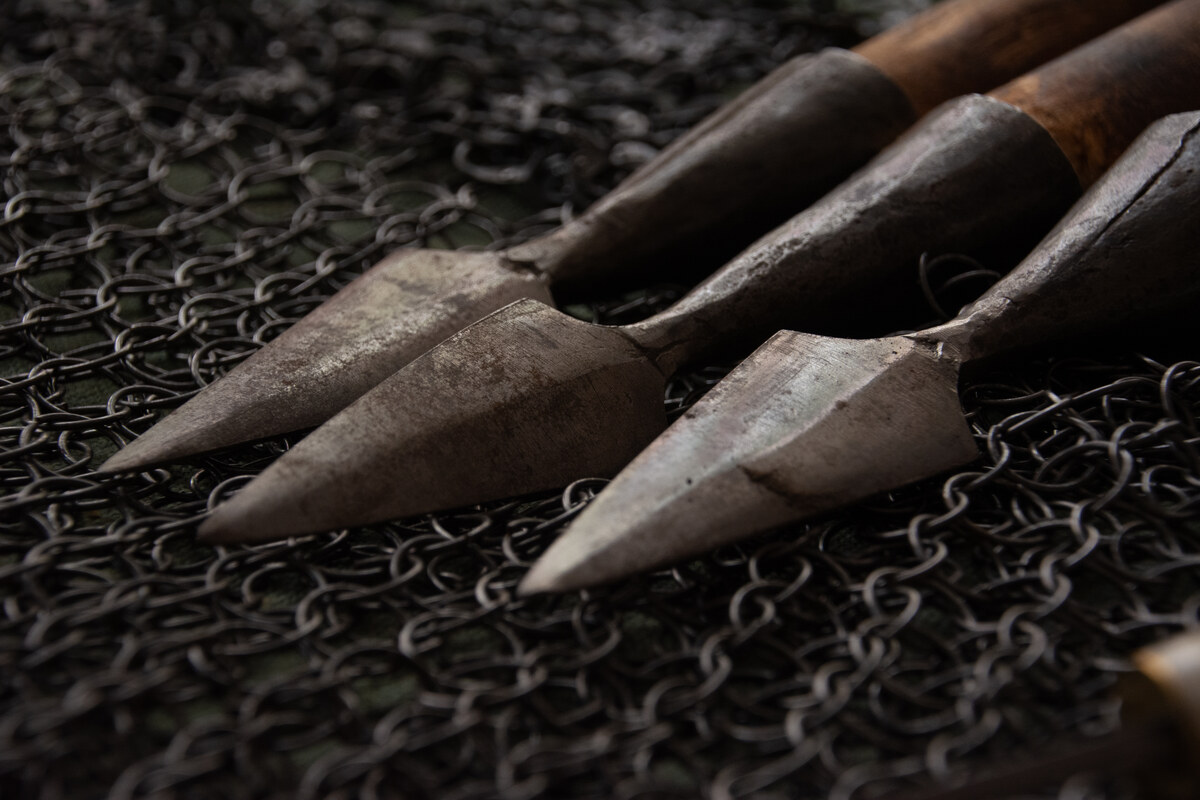
In the 15th century, the spear that pierced Christ on the cross could be found in Paris, Nuremberg, Constantinople and Armenia at once. Then Rome got one too.
Each city’s relic was venerated as the real Holy Lance. Some even had rival claims to the same history. The surprising part is that medieval people knew it perfectly well.
A spear with no name and no owner
The Gospel of John is the only Gospel that mentions the lance. To make sure Jesus was dead, it says, a Roman soldier stabbed him in the side. The soldier is never named.
The name Longinus came later, from the apocryphal Gospel of Nicodemus, attached to late manuscripts of the 4th-century Acts of Pilate. In the late 6th-century Rabbula Gospels, the name “LOGINOS” appears above the soldier’s head, one of its earliest known records.
Around 530, a guide for pilgrims already placed the lance in Jerusalem’s Church of the Holy Sepulchre. From there, the story gets complicated very quickly.
The myth of the one true lance
In 614, a Sasanian Persian army captured Jerusalem. According to the Chronicon Paschale, the lance was taken to Hagia Sophia in Constantinople that same year. Yet in 670, the pilgrim Arculf reported seeing it back in the Holy Sepulchre.
Constantinople kept its lance anyway. After the crusaders sacked the city in 1204, the new Latin emperor Baldwin II ran out of money and sold 22 relics to King Louis IX of France. The lance probably reached Paris in 1242 and was enshrined in the Sainte-Chapelle.
Travelers, however, kept describing a lance in Constantinople. The travel writer John Mandeville, whose account is itself questionable, described both, noting that the one in Constantinople was much larger than the one in Paris.
A sultan’s gift that worried Rome
In 1453, Mehmed II conquered Constantinople. In 1492, his son Bayezid II sent a lance to Pope Innocent VIII, to encourage him to keep Bayezid’s brother and rival Cem in captivity.
The gift caused real unease. As Johann Burchard records, Rome had serious doubts about it, because rival lances already existed in Paris, Nuremberg and Armenia. The Roman relic stayed anyway, and still rests in St Peter’s Basilica, above Bernini’s statue of Saint Longinus.
In the mid-18th century, Pope Benedict XIV found an elegant solution. After comparing a drawing of the Paris lance with the Roman blade, he concluded the Paris relic was simply the broken tip of the Roman one.
The emperor’s lance that changed identity
The lance now displayed at the Hofburg in Vienna has its own story. King Henry the Fowler bought it in 926 from Rudolf II of Burgundy, then carried it into the Battle of Riade on 15 March 933, the feast day of Longinus.
By 1008, as German rulers learned about the Byzantine lance, the same spearhead had quietly become the lance of Saint Maurice instead. A silver sleeve made for Henry IV says exactly that. Around 1354, Charles IV wrapped it in a gold sleeve inscribed “LANCEA ET CLAVVS DOMINI”, “the lance and nail of the Lord”, reclaiming the link to the Crucifixion.
Modern analysis in Vienna dated the spearhead to the 8th or early 9th century, and ruled out a 1st-century origin for the nail set into it.
The man who dug one up
The strangest lance appeared during the First Crusade. In 1098, at Antioch, a soldier of humble origin named Peter Bartholomew, once a servant, claimed Saint Andrew had shown him in visions where the relic lay buried. On 14 June 1098, after digging up the floor of the Church of St Peter, he produced a lance.
The papal legate Adhemar of Le Puy believed Peter was a charlatan who had simply brought a piece of iron with him. The army still credited the lance with its victory at Antioch. On 8 April 1099, to silence the doubters, Peter walked through an ordeal by fire. He was very likely badly burned, and he died on 20 April.
Greek sources add a twist: a lance relic was already kept in that same church in the 10th century, possibly buried in 1084 to hide it from the Seljuks.
More than an object, a source of power
Armenia, meanwhile, venerated its own lance at Geghard, the “Monastery of the Holy Lance”, said to have been brought by the Apostle Thaddeus. It is still displayed in Vagharshapat today.
Several lances, then, but never quite a scandal. For medieval kings, crusaders and popes, a Holy Lance was less a piece of evidence than a promise of victory and legitimacy, and everyone wanted their own.