In the late 1280s, somewhere in northern Italy, someone figured out how to put two pieces of glass in front of tired eyes. Within twenty years, preachers were talking about it like a product launch, and Venice was already writing rules for who could sell it.
Before glasses, there was the reading stone
People had known for a very long time that curved glass makes things look bigger. The Roman writer Seneca noticed that an object seen through a glass ball filled with water appeared larger. Pliny the Elder even described Emperor Nero watching gladiator fights through an emerald.
The medieval answer was the “reading stone”, a magnifying lens laid directly on the page. It worked, but you had to slide it along line by line, like reading with a magnifying glass on a phone screen.
The science behind it was building up too. The scholar Alhazen laid the foundations of physiological optics around the year 1000, and Latin translations of his work reached Europe in the 12th century. In his Opus Majus of 1268, the Franciscan friar Roger Bacon demonstrated that specially shaped glass lenses could enlarge small letters.
A friar announced it like a tech launch
The real breakthrough came in northern Italy in the second half of the 13th century: lenses you could wear on your face. We know how new this felt thanks to a sermon given on 23 February 1306 by the Dominican friar Giordano da Pisa.
“It is not yet twenty years since there was found the art of making glasses, which make for good vision,” he told his audience. He insisted on how fresh it all was: “this new art, never before extant, was discovered.”
Read today, it sounds a lot like someone explaining a gadget that had only just hit the market. A whole generation of readers could still remember the world before it existed.
Early adopters were not hard to find either. Alessandro della Spina of Pisa, who died in 1313, started making glasses himself, and a record says he “made them and shared them with everyone with a cheerful and willing heart.” An open-source spirit, seven centuries early.
Venice turned it into a regulated industry
Every hit product eventually needs a supply chain, and medieval Italy had the perfect one. Venice, with its glassmakers on Murano, could produce glass so clear that it rivalled rock crystal.
Things moved fast. By 1301, guild regulations in Venice were already governing the sale of spectacles, barely fifteen years after their invention. Crystal workers obtained permission in 1302 to use optical glass for reading. In 1320, Venice’s spectacle makers formed their own separate guild.
Think of it as the medieval version of a new industry getting its own trade association and rulebook within a couple of decades.
What the first models actually looked like
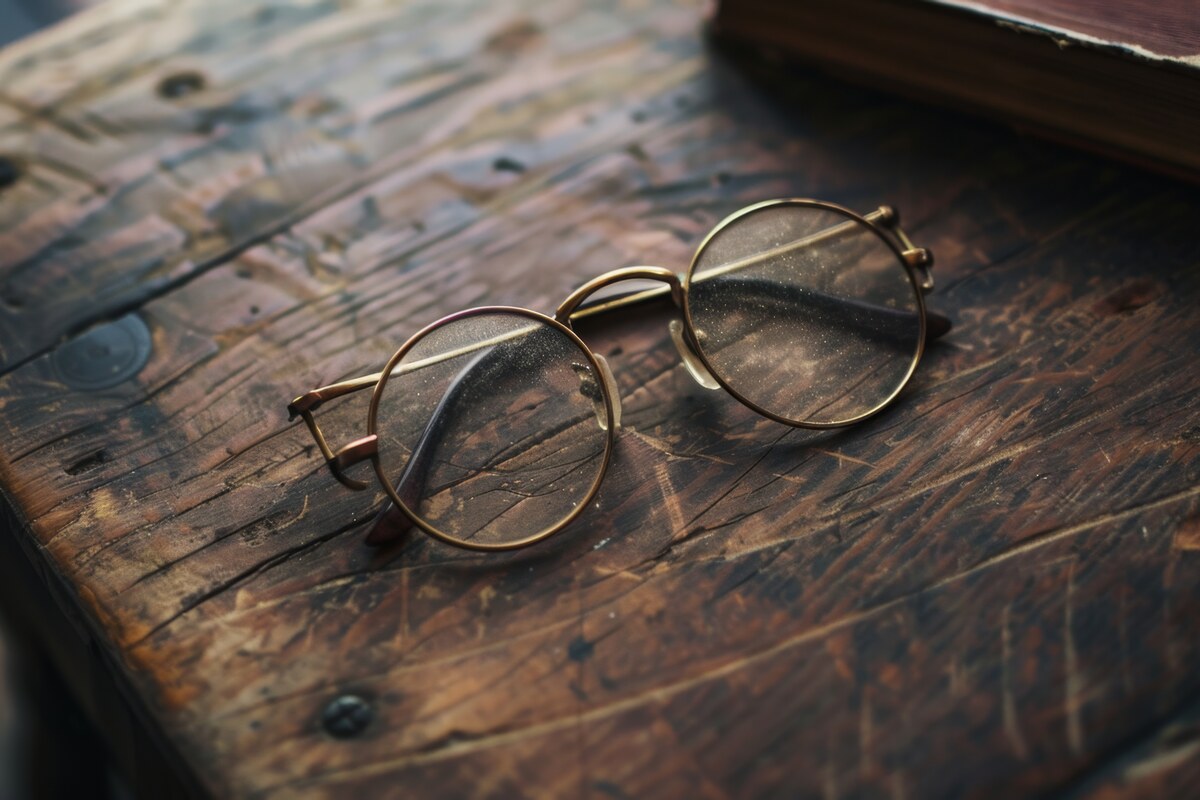
Forget arms hooked over the ears. The first spectacles simply sat on the nose. The so-called “rivet spectacles” were two round convex lenses of Murano glass, set in rims of wood, horn, or leather, and joined by a single rivet.
They let wearers see with both eyes at once, but they had a clear limit: they only helped with farsightedness and age-related blurry vision. If you were nearsighted, version 1.0 did nothing for you.
The upgrades came slowly. In the 15th century, the rivet was replaced by a bridge, and the arrival of printing pushed demand even higher. Concave lenses for nearsighted people appeared in Florence around 1440, first mentioned in a 1451 letter addressed to Cosimo de’ Medici.
The first glasses ever painted
In 1352, the painter Tommaso da Modena portrayed Cardinal Hugh de Saint-Cher wearing a pair, the earliest known picture of someone using glasses. North of the Alps, they show up on an altarpiece in the church of Bad Wildungen, in Germany, dated 1403.
The invention also attracted the kind of myths that surround any famous product. In the 17th century, Francesco Redi credited a Florentine named Salvino degli Armati with inventing glasses, a claim since exposed as erroneous. And there is no evidence that Marco Polo saw glasses in China: the earliest Chinese mentions date from the 15th century and describe them as imported.
A medieval idea still sitting on your nose
Medieval Europe is often imagined as a place where nothing changed for centuries. Yet here is a device that went from unknown to preached about, mass-produced, and regulated in a single lifetime.
The next time you push your glasses up your nose, remember that the gesture began with a few craftsmen in 13th-century Italy, and a friar who could hardly believe how new it all was.