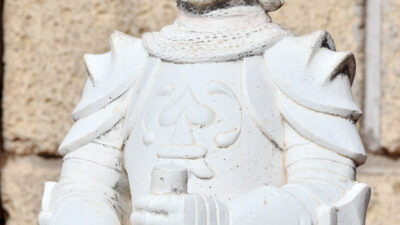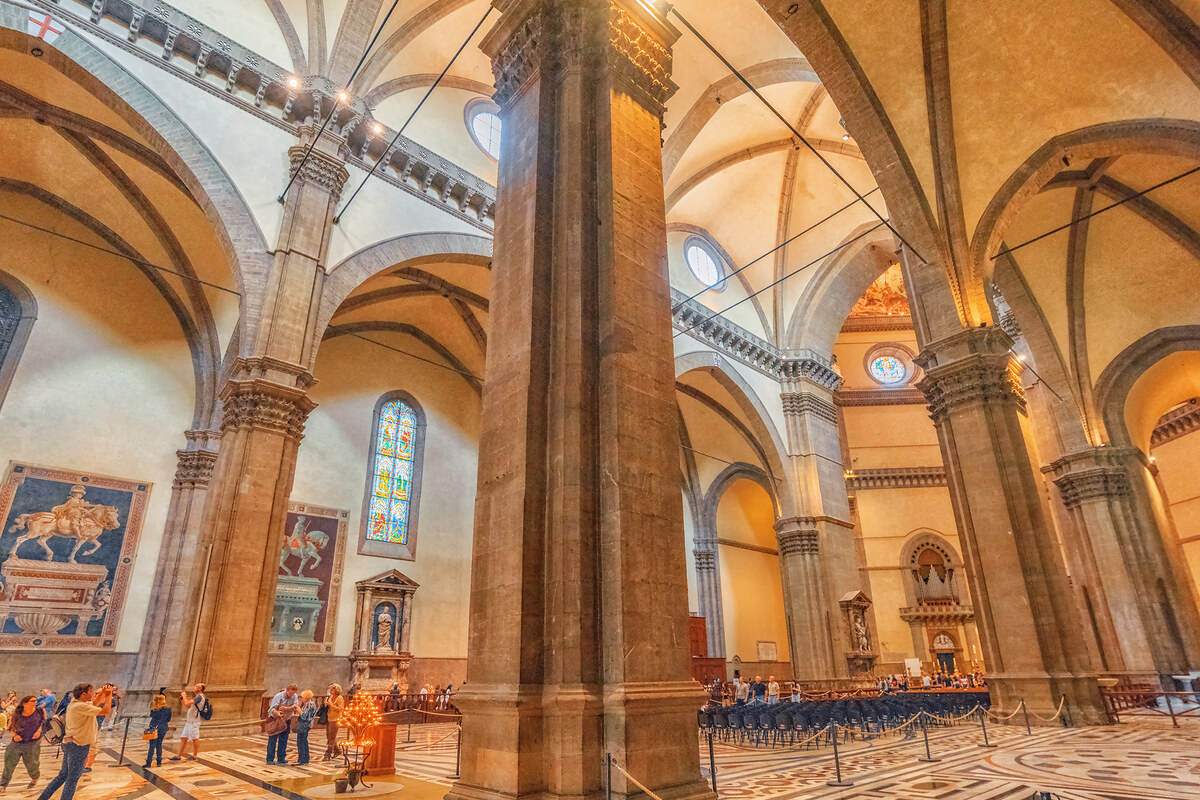
He was born in a small Essex village around 1320, the second son of a tanner. He died in Florence in 1394, and four decades later the city painted him on the wall of its cathedral, riding a horse like a bronze statue. In between, John Hawkwood fought for almost everyone in Italy, including the city that ended up honoring him.
From English archer to Alpine adventurer
Hawkwood’s father, Gilbert, was a tanner and a fairly wealthy minor landowner in Sible Hedingham. Nothing about that start pointed to a career that would make him one of the most famous soldiers in Europe.
He learned his trade in the Hundred Years’ War, serving King Edward III as a longbowman. Some historians argue he fought at both Crécy in 1346 and Poitiers in 1356. Exactly when and by whom he was knighted remains unclear.
Then peace broke out. After the Treaty of Brétigny in 1360, thousands of English and French veterans suddenly had no war to fight. Many of them crossed the Alps into Italy, where rich and rival city-states were happy to pay for professional soldiers.
The White Company and its strange way of fighting
Hawkwood joined one of these bands, the White Company. In 1361 it fielded around 3,500 cavalry and 2,000 infantry, mostly English and French veterans, with Germans, Italians and Hungarians mixed in.
Its basic unit was the “lance”, a team of three: a man-at-arms, a squire and a page. The name of the company itself is still debated. The traditional story credits the brightly polished armor of its men-at-arms, while historian William Caferro has suggested they simply wore white surcoats.
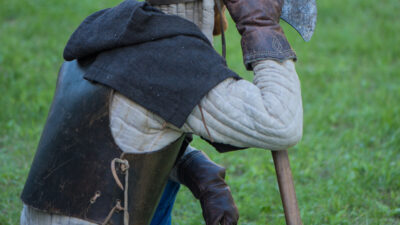
What really shocked Italian observers was how these men fought. They dismounted and advanced in close order at a slow pace, with two men-at-arms holding the same lance, while longbowmen shot from behind them. It was the English battlefield playbook, exported south of the Alps.
A sword for hire, paid in florins
In Italy, Hawkwood became “Giovanni Acuto”, roughly “John Sharp”. By the mid-1360s he was a commander, and over the next three decades he worked for Pisa, for the Pope, for the powerful Visconti of Milan and for Florence, often switching sides as contracts changed.
The money was staggering. Over thirty years he earned between 6,000 and 80,000 florins a year. A skilled Florentine craftsman of the same era earned about 30 florins a year.
Sometimes he was paid simply to go away. During a great raid on Tuscany, Tuscan ambassadors handed him 130,000 florins in exchange for a truce.
The dark side of the contract
This was not a romantic career. In February 1376, when Pope Gregory XI failed to pay him, Hawkwood’s troops looted the town of Faenza. In 1377, he took part in the massacre of unarmed civilians at Cesena.
That same year, he made a very strategic marriage. His bride was Donnina Visconti, an illegitimate daughter of Bernabò Visconti, the lord of Milan whose forces Hawkwood had defeated at Rubiera in 1372 with a thousand lancers.
Florence’s favorite foreigner
His greatest feat came at the battle of Castagnaro in 1387, fighting for Padua. A Paduan chronicle reported that 4,620 fighting men were captured. It is still described as one of the great military achievements of the age.
Florence, the city that had once paid him to leave, eventually hired him to lead its troops against Milan in 1390 to 1392. It granted him citizenship and an unprecedented lifelong pension of 1,200 florins a year.
When he died at his Florence home on 17 March 1394, the city spent 410 florins on a lavish funeral in the cathedral. England’s King Richard II even asked for his body to be sent home.
A painted statue for a hired soldier
In 1436, Florence commissioned the painter Paolo Uccello to honor him in the cathedral. Using a green earth technique called terra verde, Uccello made the fresco look like a bronze equestrian statue. The Latin inscription calls him “the most prudent leader of his age and most expert in the art of war”.
It is a strange monument when you think about it. A tanner’s son from Essex, who once pillaged Italian towns for pay, still watches over one of the most famous churches in the world. Few careers show so clearly how, in medieval Italy, war had become a business, and the best businessmen could end up as heroes.