Every medieval church owned its own version of the holy grail. It wasn’t hidden in a castle or guarded by knights. It sat in plain sight on the altar, and most people in the pews were never allowed to touch it.
Not a legend, a cup on every altar
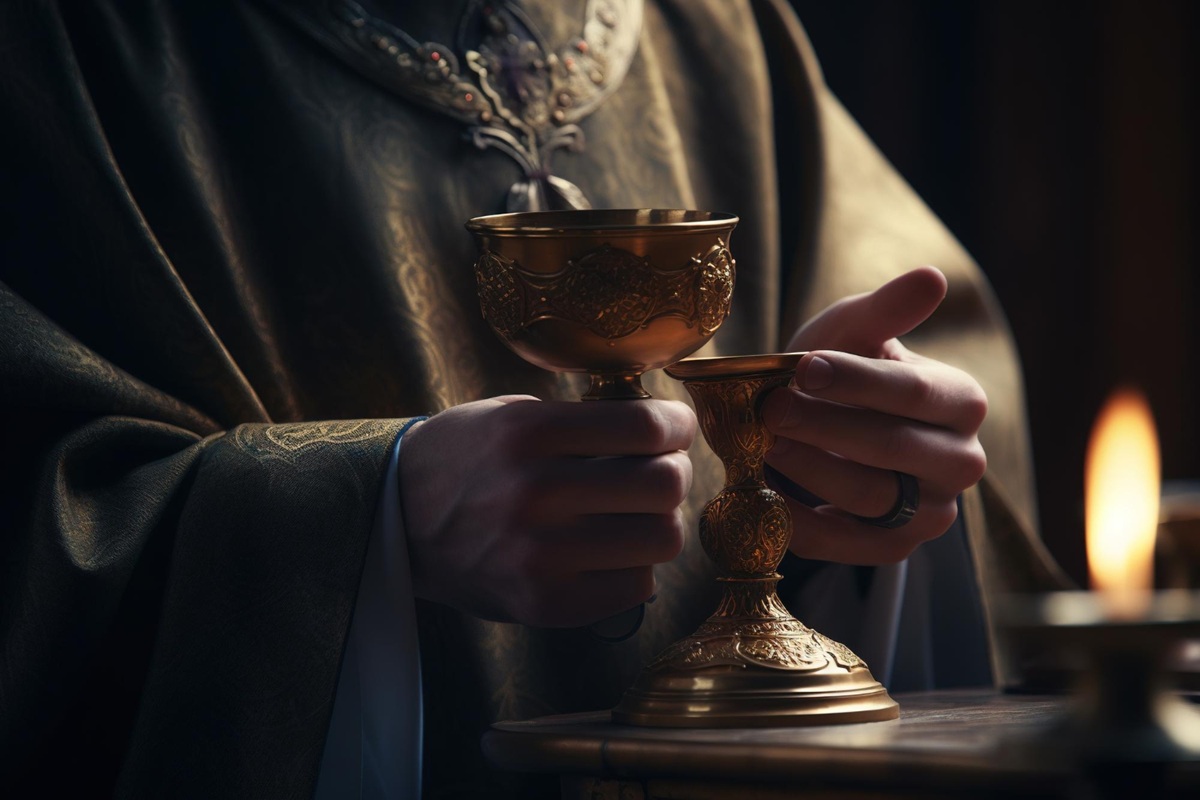
The object is called a calice, or chalice: a flared cup set on a raised stem, used to consecrate wine during the Eucharist. The name comes from the Greek kulix, simply meaning cup.
It wasn’t a decorative afterthought. After the consecrated host, the chalice was considered the single most sacred object a medieval church possessed, the direct stand-in for the cup shared at the Last Supper.
Why most people never got to drink from it
It’s easy to assume every medieval Christian took communion the way modern churchgoers imagine it, bread and wine together. That stopped being true for ordinary worshippers by around the 12th century.
From that point on, only the celebrating priest drank the wine. The laity received the host alone. The chalice, and everything in it, was reserved for the clergy at the altar.
The reasoning was practical as much as theological: spilling what was believed to be the blood of Christ was treated as a serious risk, one the Church preferred to avoid entirely by simply removing the cup from lay hands. The Fourth Council of the Lateran, in 1215, reaffirmed the doctrine of transubstantiation, hardening the chalice’s status as something too sacred to risk.
An object engineered for shaking hands
Look closely at a medieval chalice and there’s a swelling partway down the stem, called the knop. It isn’t decoration. It exists so a priest, whose hands might genuinely tremble while consecrating the wine, has something solid to grip without risking a spill.
The materials tell their own story. The earliest Christian chalices were made of plain wood or clay. By the high Middle Ages, parish and abbey chalices had shifted toward gold, silver, gemstones and enamel, though plenty of rural parishes still made do with bronze or tin, sometimes just gilded on the inside to satisfy church rules.
Some of the finest examples came out of Limoges, whose workshops became famous across Christian Europe in the 12th and 13th centuries for chalices finished in champlevé enamel. Even a goldsmith-archbishop, Saint Dunstan of Canterbury, was credited with crafting sacred vessels himself.
The cup that hid a relic inside itself
Some medieval chalices weren’t just cups. Their makers embedded actual relics inside the stem or the knop, quietly turning a eucharistic vessel into a reliquary, two sacred categories fused into one object.
Wealthy abbeys treated their best chalices like legal assets. Treasury inventories described them with the precision of a notarized contract: exact gemstone counts, weight in ounces, the donor’s name, sometimes even the goldsmith’s name.
That value is also why chalices kept disappearing from view. During Roman persecutions, during the French Revolution, and again under 20th-century communist regimes, priests and communities hid their chalices rather than surrender them, proof of how irreplaceable these objects were believed to be.
A cup that even named a place
The word’s reach goes further than the altar. Galicia, the region in northwestern Spain, carries an etymological link back to the same word, and a chalice still appears on its coat of arms.
The real holy grail was never lost in some distant legend. It stood on the altar of nearly every medieval church, close enough to see, and for almost everyone in the congregation, permanently out of reach.