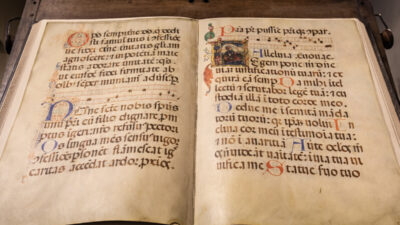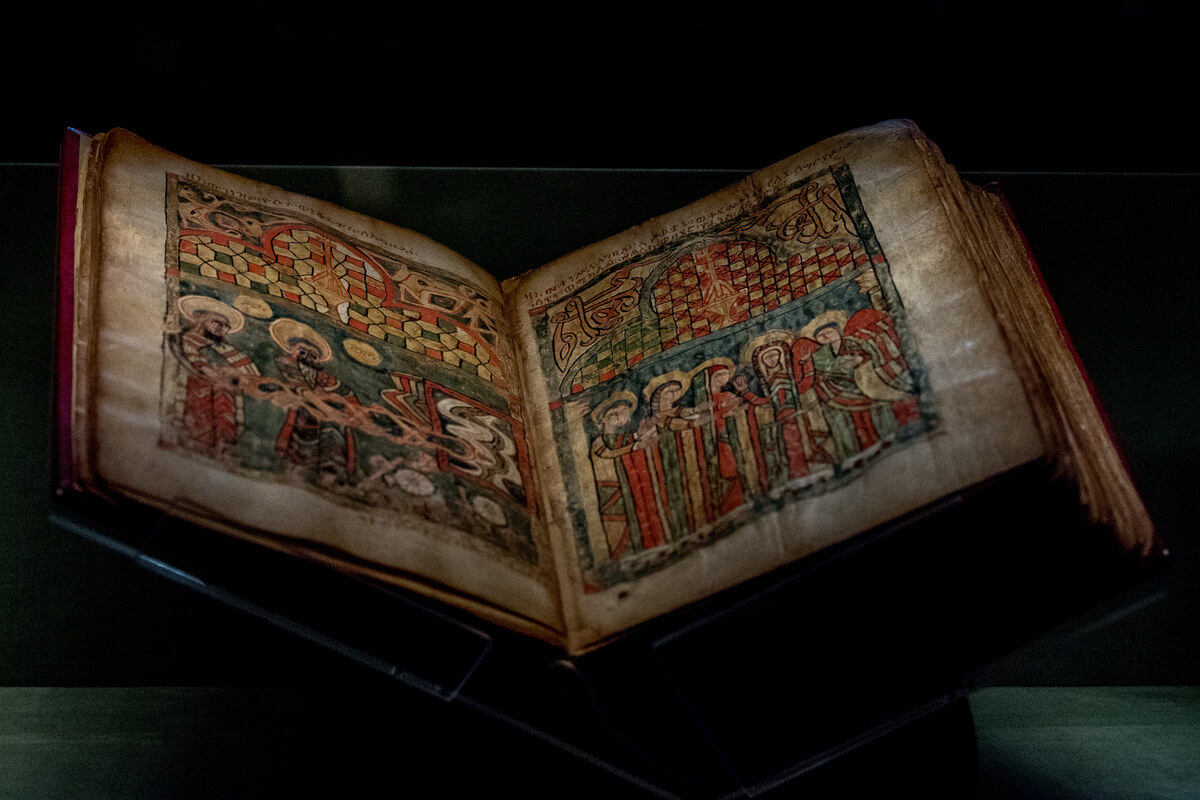
In a library in Stockholm sits a medieval Bible that is 92 cm tall, 22 cm thick and weighs 74.8 kg, roughly as much as a grown man.
It is called the Codex Gigas, Latin for “giant book”, and it is the largest known medieval manuscript in the world. Most people know it by its other name: the Devil’s Bible.
A book the size of a piece of furniture
Very large Bibles were normal in Romanesque monasteries. Even among them, the page size of the Codex Gigas is exceptional: 92 cm long and 50 cm wide, bound in wooden boards covered with leather and ornate metal fittings.
Inside are 310 leaves of vellum. They are said to come from the skins of 160 donkeys, or perhaps calves. Laid flat, the pages would cover 142.6 square metres, about the floor area of a large family house.
It was not always this “small”. The book originally held 320 sheets, and twelve were later cut out. Nobody knows who removed them, or why.
One night with the Devil, or twenty years alone
A legend recorded as early as the Middle Ages explains how such a book could exist. A monk broke his vows and was sentenced to be walled up alive. To save himself, he promised to write, in a single night, a book containing all human knowledge.
Near midnight, desperate, he prayed to Lucifer for help in exchange for his soul. The Devil finished the book, and the grateful monk painted his portrait inside.
The truth is slower and, in its way, more impressive. Handwriting analysis shows the book really was written by one monk, credited as Hermann Inclusus, “Herman the Recluse”. But it took him an estimated 20 to 30 years. The codex is now generally dated between 1204 and 1230, in the Benedictine monastery of Podlažice, in Bohemia (today’s Czech Republic).
What fed the legend is the script itself. It stays perfectly uniform from start to finish, with no sign of the scribe’s age, illness or fatigue. Imagine a single person keeping the same handwriting for two decades, page after page.
A whole library in one binding
The Codex Gigas is not just a Bible. It works more like a medieval hard drive, packing an entire reference shelf into one object.
Alongside the complete Latin Bible, it holds the histories of Flavius Josephus, the encyclopedia of Isidore of Seville, a chronicle of Bohemia by Cosmas of Prague, and medical treatises, including two books by Constantine the African. The first pages even show Hebrew, Greek, Latin, Glagolitic and Old Cyrillic alphabets.
It ends with very local records: a list of the monks of Podlažice, a calendar of the dead, prayers, and a page of “three adjurations and two charms”.
The pages that turned black
On folio 290, an otherwise empty page, stands the Devil himself, about 50 cm tall. He crouches with his arms raised, his head dark green, with red claws, red horns and two red tongues sticking out of his mouth. His white loincloth is dotted with small red dashes, often read as ermine tails, a common symbol of sovereignty.
Facing him, on the opposite page, is a full-page image of the Kingdom of Heaven. Good and evil, side by side.
The pages just before this spread are strangely dark. That is not decoration. Over the centuries, readers kept flipping straight to the famous portrait, and the light slowly blackened the vellum around it.
Pawned, seized and thrown out of a window
The book’s later life reads like an adventure novel. Shortly after it was made, the Benedictines pawned it to the Cistercian monks of Sedlec Abbey, who kept it for 70 years. It passed through other monasteries until 1594, when Emperor Rudolf II took it to Prague for his personal collection.
In 1648, at the end of the Thirty Years’ War, the Swedish army carried off the whole collection as war booty. The codex has been in Stockholm ever since.
On 7 May 1697, fire tore through the Tre Kronor royal castle and destroyed much of the Swedish Royal Library. The Codex Gigas was saved by being thrown out of a window. According to a local vicar, it landed on a bystander and injured him. With 74.8 kg falling from above, he was lucky.
A record that still stands
Eight centuries later, the Devil’s Bible is still on public display at the National Library of Sweden. Its true story has no demon in it, just one patient monk and decades of work.
Perhaps that is the real reason the legend survived: it is easier to believe in a deal with the Devil than in twenty years of quiet, stubborn effort.