Lord Byron made him a noble martyr chained to a pillar. The real François Bonivard was a Savoyard monk with a taste for parties, four marriages and permanent debt, and he spent six years underground in Chillon Castle for choosing the wrong side.
Today Chillon is one of the most visited medieval castles in Europe. Its most famous inmate, though, was nothing like the hero of the poem.
A prior who preferred amusements to books
Bonivard was born in 1493 at Seyssel, into a noble family of Savoy. He was sent to study at Pinerolo, Italy, at the age of seven, and he reportedly preferred amusements to learning for most of his youth.
It did not hurt his career. In 1510, after the death of his uncle, he took over as prior of St.-Victor, a monastery just outside the walls of Geneva. Most accounts describe him as a libertine, despite his vocation.
How a Savoyard ended up fighting Savoy
Then the Duke of Savoy, Charles III, seized the Bonivard family property, leaving only the priory. Bonivard sided with the patriots of Geneva who resisted the duke’s efforts to control the region.
In 1519 he fled the city disguised as a monk after hearing that the duke was approaching. Friends he trusted betrayed him and handed him over. He spent two years in the duke’s castle of Grolée on the Rhone, from 1519 to 1521.
Six years below the lake
Prison did not slow him down. Bonivard returned to his priory in 1527 and went on with his political activism. In 1530 he thought he could spend a safe night in Moudon, but the duke’s men caught him and handed him over again.
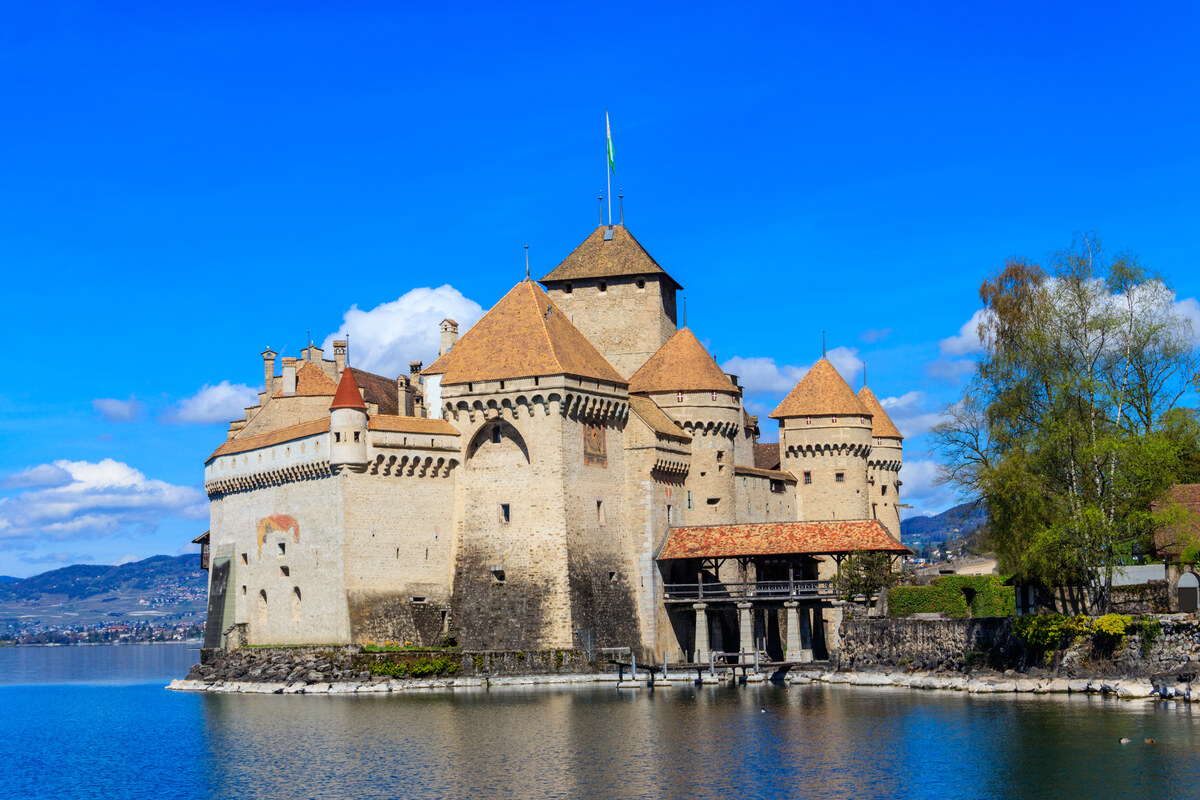
This time he was locked up underground in the Castle of Chillon, which sits on a rock on Lake Geneva and controlled the road between Burgundy and the Great Saint Bernard Pass. The counts of Savoy used it as a summer home, kept a fleet of ships on the lake, and also used it to house prisoners.
In 1536 a Bernese army captured the castle, and every prisoner, Bonivard included, was released.
A hero with an unglamorous second act
Freedom brought a pension from Geneva, a seat on the Council of Two Hundred in 1537 and a salary to go with it. His priory, however, had been razed in the meantime.
He was married four times. By one account, his first wife managed his estate well, while Bonivard was dedicated to spending money and hosting dinners for his friends, to the scandal of the neighborhood. Neighbors urged him to marry again to calm things down, so at sixty-nine he wed a former nun. A few years later she was arrested at home for immorality and infidelity, and she was executed by drowning in the Rhone.
He was perpetually in debt, yet he left something real behind. In 1542 he was asked to write a history of Geneva, and he took it up to the year 1530. In 1551 he donated his considerable library to the public, and he left everything to the city in his will. He died in 1570, at 77.
How Byron turned him into a legend
In 1816 Lord Byron visited the castle and was inspired by Bonivard’s story. He wrote The Prisoner of Chillon, and Byron supposedly carved his own name on a pillar of the dungeon. In 1835 Eugène Delacroix exhibited a painting inspired by the poem.
The legend kept growing. In 1890 the watchmaker Edouard-Gabriel Wuthrich finished a mechanical automaton, five years in the making, showing the Bernese capture of the castle and Bonivard’s liberation. It has one hundred moving figurines, including scenes of torture visible through barred windows. It vanished for decades, then was bought back in 2016 at an auction in Paris for 59,000 Swiss francs.
The prisoner nobody remembers writing
The poem made Bonivard famous for suffering. His own chronicle of Geneva was sent to John Calvin for correction in 1551, yet it was not published until 1831.
The man history remembers for sitting in a dungeon spent most of his life arguing, borrowing and writing, which says something about who gets to become a legend.