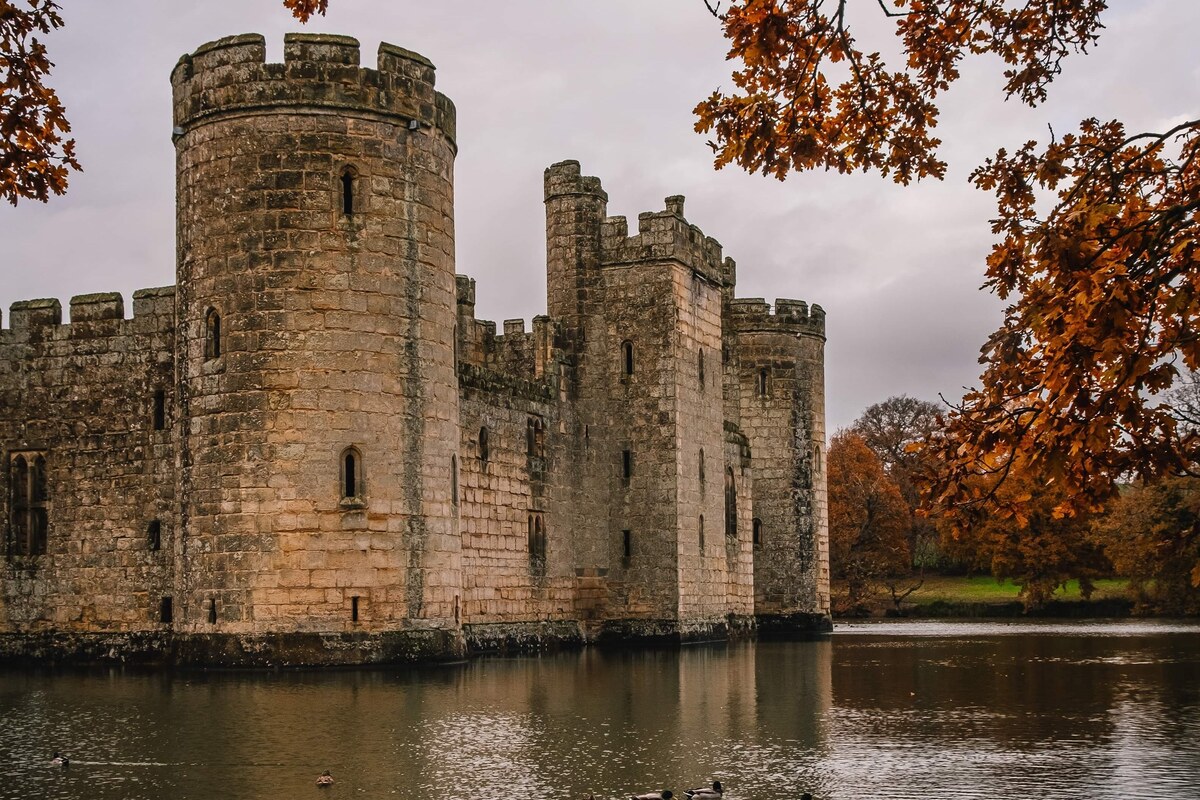
From the outside, Bodiam Castle is everything a medieval castle should be: round towers, battlements, a gatehouse bristling with murder holes, all rising out of a wide moat. Look closer, and the fortress starts to behave a lot more like a rich man’s show home.
A licence written in a moment of panic
In 1385, southern England was frightened. A fleet of 1,200 ships, cogs, barges and galleys, had gathered across the Channel at Sluys in Flanders, and an invasion looked like a real possibility.
That October, Richard II granted Sir Edward Dalyngrigge a licence to turn his manor house at Bodiam into a castle. The wording was all about war: “for the defence of the adjacent country, and the resistance to our enemies.”
Dalyngrigge had already worked on plans to fortify Winchelsea and Rye. On paper, Bodiam was a frontline fort.
Paid for with plunder
Dalyngrigge was a younger son, cut out of his father’s estates, so he had to make his own fortune. He did it in France. In 1367 he joined the free company of Sir Robert Knolles, a notorious mercenary commander said to have made 100,000 gold crowns from pillage and plunder.
He came home in 1377 with money and influence, married the heiress of the Bodiam manor, and sat for Sussex in ten parliaments. He was also hot-headed: in a lawsuit against John of Gaunt, he twice threw down his gauntlet in the middle of the court.
The money that built Bodiam came from the same kind of war it was supposedly built to resist. A carving of Knolles’ coat of arms still sits above the castle’s rear gate, a reminder of the mercenary world that paid for it.
A fortress with picture windows
Here is where the story wobbles. The licence allowed Dalyngrigge to fortify his existing manor, but he picked a brand new site instead, and a survey by the Royal Commission concluded it was unusually placed for coastal defence, far from the medieval shoreline.
The moat, the castle’s most famous feature, averaged only about five feet deep. In the 1990s debate over Bodiam, it was suggested the moat could have been drained in a single day, because the bank holding it in was not substantial.
Then there are the walls. Gun-loops appear only in the gatehouse, while the curtain walls and towers are studded with large windows for domestic comfort, weak points for any serious attacker. Inside, it was laid out like a grand house, with a great hall, kitchens, a chapel and private apartments.
Even the approach was staged. Visitors followed an indirect route around the moat and ponds, giving them time to admire the castle in its full splendour. Archaeologists Oliver Creighton and Robert Higham call Bodiam one of the best examples of a landscape designed to show off a castle.
An old soldier’s dream house
In the 1960s, Bodiam was described as “an old soldier’s dream house”, and the label stuck. Its water features made it look bigger and more impressive, and today the moat is seen as more ornamental than defensive.
It was not all for show, though. The gatehouse had three wooden portcullises and murder holes, and military historian Cathcart King considered the approach as formidable as Edward I’s castles in Wales. Bodiam was a real castle that cared deeply about how it looked.
And the romance had limits. The castle’s 28 toilets drained straight into that picturesque moat, turning it into what archaeologist Matthew Johnson called an “open sewer.”
Dalyngrigge barely enjoyed any of it. By 1390 the threat from France had receded, and he was dead by the mid-1390s.
From dream house to Swamp Castle
Bodiam’s real test came centuries later. In 1644 the Royalist Earl of Thanet sold it for £6,000 to help pay a £9,000 fine imposed by Parliament, and the castle was probably slighted soon after, losing its barbican, bridges and interior buildings.
Its looks saved it. By the 18th century the ivy-covered ruin was an early tourist attraction. Lord Curzon, who bought it in 1916, drained the moat and cleared three feet of mud before it passed to the National Trust in 1925.
Fittingly, a castle built partly for show became a film star. In Monty Python and the Holy Grail (1975), Bodiam plays “Swamp Castle”, which, given what flowed into its moat, is not entirely unfair.
Why the perfect castle is a bit of a fake
Historian Charles Coulson put it neatly: Bodiam “represents the popular ideal of a medieval castle.” The castle most people picture when they think “medieval” was designed, from the start, to be looked at. Perhaps our image of castles owes as much to medieval vanity as to medieval warfare.